


| August 20, 2026
Summary: Web design and development for education helps universities create fast, accessible and student-focused digital experiences. With the right university website development, institutions can make information easier to find, strengthen engagement and guide prospective students from discovery to application.
Picture yourself at home, evaluating three different universities on your laptop: one of them features a very user-friendly website where you can find information about programmes, eligibility criteria, fees and placements within a few seconds; another website has amazing graphics, but requires quite some clicks to provide information regarding courses offered and the third website opens slowly, features a complicated navigation structure and has an out-of-date page for admissions. Which university looks trustworthy?
For many students, this comparison happens long before a campus visit or conversation with an admissions counsellor. A recent study by SearchStax, in collaboration with The Chronicle of Higher Education, found that 93% of prospective students rely on college websites when making enrolment decisions. Yet only 19% of higher-education professionals surveyed said their institution currently delivers a strong website experience.
This is why web design and development for education has moved beyond creating an attractive digital brochure. A university website needs to inform, guide, reassure and help students take the next step.
Before stepping onto the campus of their chosen university, many students have already spent hours exploring the digital campus. They seek programs, compare universities and search for answers about costs, placements and campus life.
The importance of this first digital touchpoint is reflected in Carnegie’s Higher Ed SEO Benchmarks Report, which analysed data from 200+ higher-education websites:
This makes the website more than an online brochure. It becomes the place where prospective students discover, evaluate and begin forming an impression of the institution, making its design, content and usability critical to the student journey.
Consider the last time that you searched for something significant on the internet. You did not necessarily adhere to the website’s navigation; you searched a query, clicked through relevant pages, compared your options and looked for proof before making your next move. Students arrive at universities in this way as well.
A properly designed website will facilitate this process:
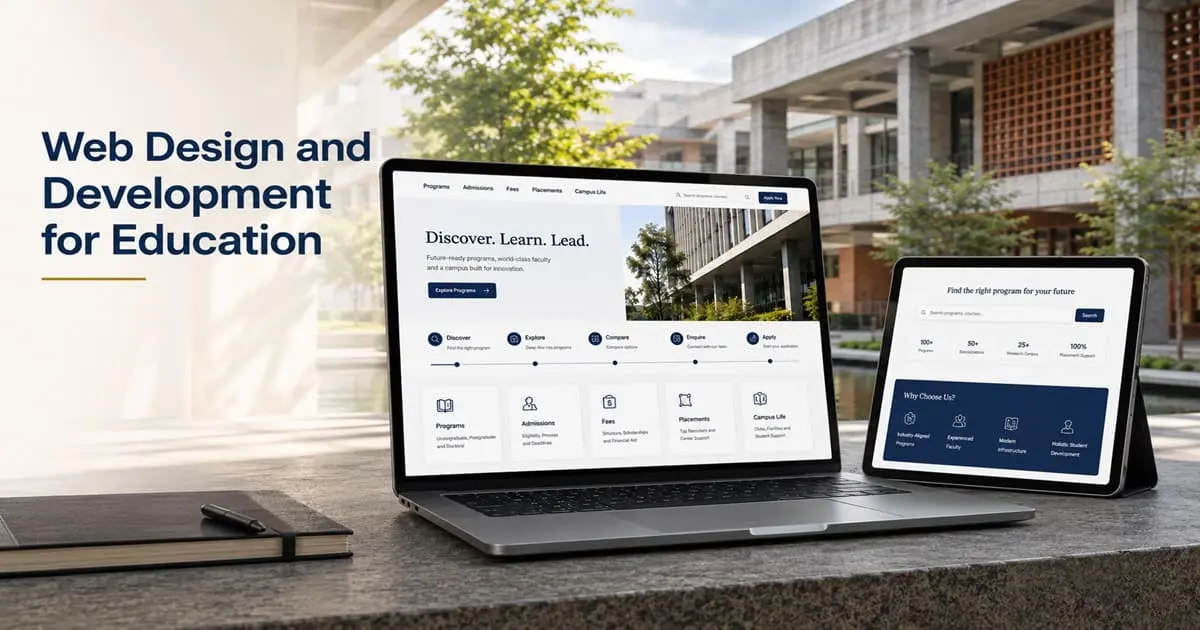
DISCOVER → EXPLORE → COMPARE → ENQUIRE → APPLY
| Student Stage | What the Website Should Deliver |
| Discover | Search-friendly pages and clear institutional information |
| Explore | Courses, campus life, faculty and student opportunities |
| Compare | Fees, eligibility, placements and differentiators |
| Enquire | Simple contact forms and relevant calls-to-action |
| Apply | Clear requirements and an easy application pathway |
It also explains the importance of website search. According to SearchStax’s research, 50% of respondents said that their website search irritated users with irrelevant or outdated results and 68% said relevant search results are extremely important to a positive website experience. This tells us that a website could have everything that a student needs and still fail if they cannot find it.
Good education web design starts with a simple question: What does the visitor need to accomplish?
The answer could be finding a programme, checking eligibility, understanding placements or starting an application. Every design decision should make that task easier.
| Website Element | What It Should Achieve |
| Navigation | Help visitors reach important information quickly |
| Programme Pages | Present course details in a clear, structured way |
| Admissions | Explain eligibility, deadlines and application steps |
| UX Design | Reduce confusion and unnecessary clicks |
| Mobile Design | Deliver a consistent experience across devices |
| Calls-to-Action | Make the next step obvious |
| Content | Answer questions throughout the decision journey |
| Site Search | Help users find specific information efficiently |
This is particularly important for universities because their websites can become large and complicated over time. New programmes, admission cycles, faculty pages, events, announcements and departmental content continually add to the digital ecosystem. The challenge is to make that complexity invisible to the user.
A beautiful homepage might create a good first impression, but it cannot compensate for a slow website, a broken enquiry form or a difficult content management system. Effective university website development must consider the technical foundation as carefully as the visual experience.
Students can research universities from smartphones, tablets or desktops. Navigation, forms, programme pages and application pathways should work smoothly across screen sizes.
An education website should be usable by people with different abilities. WCAG 2.2, the current W3C accessibility standard, is built around four principles: content should be perceivable, operable, understandable and robust.
This can involve:
Students shouldn’t have to wait for a page to load before they can see a course or application deadline. Google recommends that websites aim for a Largest Contentful Paint of 2.5 seconds or less, an Interaction to Next Paint below 200 milliseconds and a Cumulative Layout Shift below 0.1 for good Core Web Vitals.
Google also makes clear that page experience is broader than Core Web Vitals alone. Mobile usability, security, intrusive elements and overall experience quality also matter.
Design and development are often treated as two separate stages. For an education website, they should work towards the same outcome: making the student’s digital journey easier.
| Web Design Focus | Development Focus |
| Visual identity | Technical architecture |
| User experience | Functionality |
| Information hierarchy | CMS integration |
| Navigation | Search and forms |
| Page layouts | Third-party integrations |
| Calls-to-action | Performance |
| Accessibility planning | Accessibility implementation |
For example, a beautifully designed programme finder is only useful if the underlying search functionality actually produces relevant results. Likewise, an excellent admissions page loses its value if the enquiry form doesn’t work properly on mobile. The best websites make design and technology feel like one experience.
Choosing an organisation for web design and development for education shouldn’t be based on who has the more visually stunning portfolio.
Universities should ask deeper questions:
A good partner should think beyond individual pages and understand how the website fits into the institution’s wider digital ecosystem.
We believe an education website should do more than look modern. It should make it easier for students to find information, understand the institution and take the next step. That is why we build our approach around the people using the website and the goals of the institution.
Our approach includes:
We also look beyond the website itself. Our education-focused approach connects UX, website development, SEO, content and digital marketing so that the website supports the larger student acquisition and engagement journey rather than functioning as a standalone digital brochure.
For us, the objective is simple: create a website that represents the institution well, feels natural to navigate and helps turn digital interest into meaningful engagement.
A university website doesn’t need to overwhelm students with animations, endless menus or complicated features. It needs to make the right information easy to find and the next step easy to take. That means bringing together: UX + Content + Accessibility + Performance + Technology + Student Intent
When these elements work together, the website becomes more than an information hub; it becomes an important part of how prospective students experience the institution before they ever reach the campus.
For universities planning a redesign or investing in university website development, the better question isn’t “How should our website look?” It is: “What should a student be able to accomplish here and how easily can they do it?” With our education-specific approach, GrowthTrack helps institutions create digital experiences that support student engagement, enquiries and long-term growth.
It involves designing and developing websites for educational institutions with a focus on UX, accessibility, performance, content and student needs.
University websites play an important role in how prospective students research institutions, explore programmes and make enrolment decisions.
It should provide clear programme information, admissions details, fees, campus information, useful content, enquiry options and straightforward application pathways.
Good UX helps students find information quickly, reduces friction and makes the journey from programme discovery to enquiry or application easier.
It is essential because students may access university websites across smartphones, tablets and desktops.
Accessibility helps ensure that people with different abilities can navigate, understand and interact with the website.
Clear programme pages, useful content, intuitive navigation and relevant calls-to-action can help guide prospective students towards enquiries and applications.

Address:
A-68 First Floor, Sector 2, Noida, Uttar Pradesh 201301
Call Us At:
+91 7678631643
Email Us At:
business@thegrowthtrack.com
Copyright © 2026 @ growthtrack . All rights reserved.