



| November 5, 2026
There could be a situation where even a university that has excellent academic programmes, skilled faculty members and an attractive campus might find it difficult to bring in sufficient numbers of prospective students through its website. The problem may not be with the lack of digital marketing, but with the lack of awareness of what works and what doesn’t.
The scale of India’s digital audience makes this even more important. By September 2025, India had around 1.02 billion internet users, alongside approximately 750 million smartphones, making digital channels an increasingly important part of how institutions can reach prospective students.
This is where a digital marketing assessment for higher education becomes valuable.
A digital marketing assessment is a strategic process in which an individual evaluates how well a university or college uses its digital channels to engage prospective students.
The assessment does not necessarily focus on analysing the traffic and leads coming in. The correct assessment must ensure that the right individuals are being reached, the right message is conveyed to them, making the next step easier for them.
A higher education digital marketing assessment typically examines –
The objective is simple – find the gaps that are preventing digital activity from contributing effectively to enrolment.
Digital marketing actions are costly when assumptions guide them.
A university may decide to increase its Google Ad spend because of the declining inquiries, while the real issue lies with the underperforming landing page. In the same way, a university may keep blogging without validating whether these pages are bringing in the right kind of students.
An assessment brings these issues to the surface.
India’s higher education ecosystem already includes 1,289 universities, 48,246 colleges and 15,221 standalone institutions, according to Ministry of Education data. With such a large number of institutions competing for student attention, simply having an online presence is not enough.
A useful assessment should not treat every digital channel as an isolated activity. Instead, it should examine how the different parts work together.
It is also the place from which students make up their minds about the programme in most cases.
An evaluation of the site should therefore see how easily available information can be found, how well organised pages are, how easy it is to learn about admissions and what further steps are available for students.
Mobile optimisation is also worth considering since prospective students might come across programmes on mobile devices while surfing on the web or social networks.
Students search for much more than a university’s name. They may look for courses, fees, eligibility, placements, careers, specialisations, admission deadlines and comparisons between institutions.
A digital marketing assessment should identify whether the institution appears for these relevant searches.
This includes reviewing-
The aim is to understand whether the institution is visible at different stages of the student’s research journey.
A university may already have hundreds of pages and still have content gaps. Why? Because having content is not the same as answering student questions.
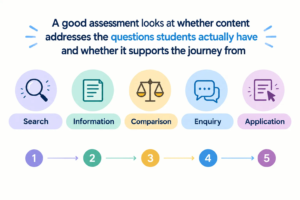
Paid advertising can generate visibility quickly, but more spending does not automatically mean better admissions. An assessment should look beyond impressions and clicks to examine –
Students may come into contact with universities via social media even before visiting the official websites of the institutions. The evaluation process should involve checking if the content on social media relates to what the prospective students want to know about the institution.
It could range from academic experience, student experience, campus life, faculty engagement, activities, etc.
At GrowthTrack, we understand that higher education marketing cannot be assessed through clicks and leads alone. The quality of the student journey, the relevance of the audience, the performance of each digital touchpoint and its contribution to enrolment all matter. That’s why our approach brings together-
If you’re looking to understand where your digital marketing is performing well, where prospective students are dropping off and what needs to change, explore GrowthTrack and contact us now.
Conducting a digital marketing assessment enables higher education institutions to better identify what influences student engagement, where they are falling off the radar, and the issues that should be addressed.
An analysis of all digital marketing components (website, SEO, content, paid advertising, social media and conversion funnel) enables institutions to make sound marketing decisions.
This is a systematic review of the website of an educational institute, including SEO, content, paid campaigns, social media, the conversion process, and analytics that help in acquiring new students.
It will help the institution to understand what is happening, where it is falling short of attracting potential students and where the digital marketing efforts can be improved without spending more on marketing budgets.
It can consist of web and user experience (UX) analysis, SEO, content, pay-per-click advertising, social media marketing, competitor positioning, and conversion journeys.
Institutions can leverage such services to become more visible, attract suitable students, increase their digital engagement, optimise conversion paths, and also make better marketing decisions using performance data.

Address:
A-68 First Floor, Sector 2, Noida, Uttar Pradesh 201301
Call Us At:
+91 7678631643
Email Us At:
business@thegrowthtrack.com
Copyright © 2026 @ growthtrack . All rights reserved.