


| September 15, 2026
Before applying, students search, compare and research. From courses and fees to placements and campus life, search engines play a key role in how students choose colleges and universities. The higher education landscape is becoming increasingly competitive, and the student journey is changing with it.
In India, the Ministry of Education’s latest data reports 1,213 universities, 46,624 colleges and 12,543 standalone institutions for 2022-23. The same data puts India’s higher education Gross Enrolment Ratio (GER) at 29.5% for the 18–23 age group.
Globally, recent higher-education research also shows how important search has become. A UPCEA and Search Influence study found that 50% of prospective students use AI-powered search tools at least weekly, while 77% consider university websites the most reliable source of information. This is where an education SEO agency can make a difference.
SEO for colleges and universities is no longer simply about ranking for terms such as “MBA college” or “B.Tech. Computer Science.” It is about creating a digital presence that helps prospective students discover an institution, understand its programmes, compare their options and eventually take action.
An education SEO agency specialises in improving the online visibility of schools, colleges, universities, edtech companies and other education-focused organisations through search engine optimisation.
Unlike conventional SEO, education SEO has to account for a much longer and more research-driven decision-making process. A prospective student may search for a course several months before applying. During this period, they may visit multiple university websites, compare rankings, read reviews, check eligibility requirements and search for placement information. An education-focused SEO strategy therefore combines –
The objective is not simply to bring more visitors to a website. It is to attract relevant prospective students who are actively researching courses and institutions.
A university website is often much more than an online brochure. It can influence how students perceive an institution and whether they continue exploring it. This highlights an important point: students don’t necessarily start their journey by searching for a particular university.
They might begin with queries such as:
If an institution appears at the right moment with useful and trustworthy information, it has an opportunity to enter the student’s consideration set. That is the real value of SEO in higher education.
Traditional SEO conversations often focus heavily on rankings. For education institutions, however, rankings are only one part of the journey. Consider a student searching for a programme. Their journey may look something like this –
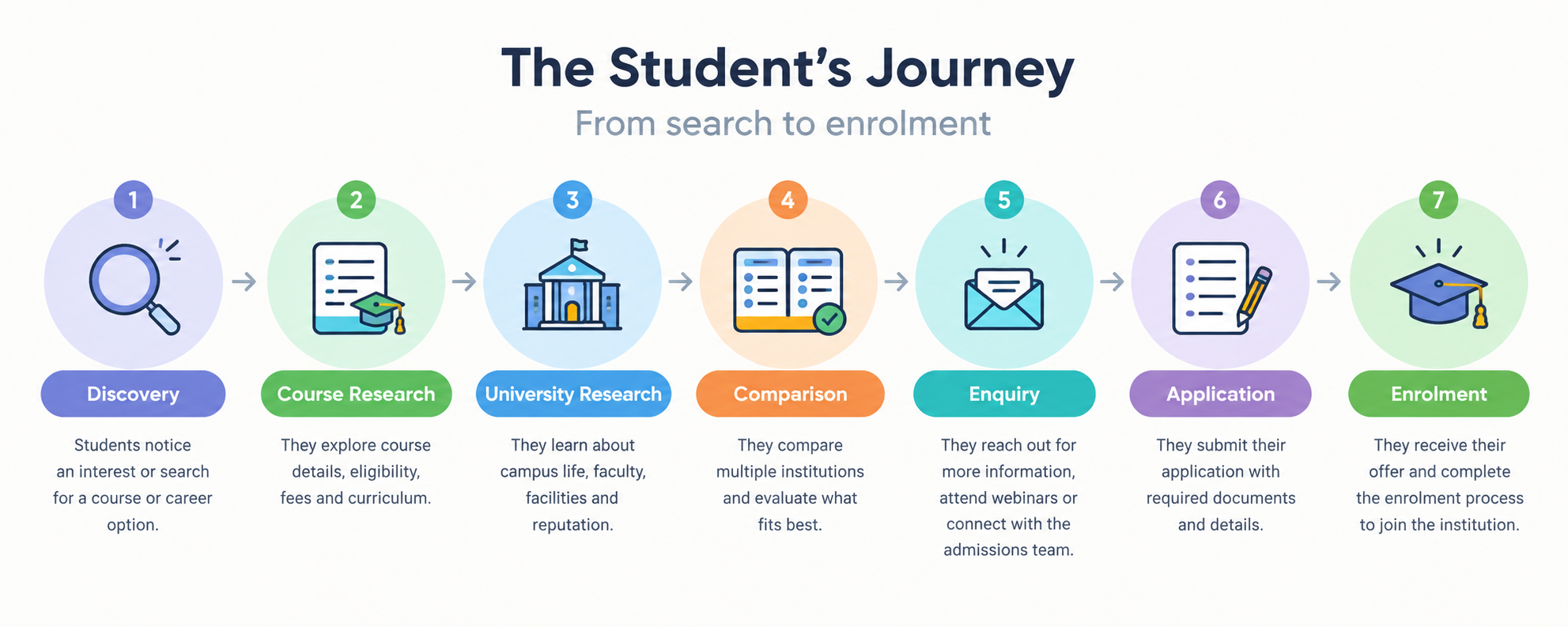
During discovery, the student may search for career options or popular MBA specialisations. Later, they may look for eligibility, fees, curriculum, and entrance requirements. When comparing universities, they may search for placements, rankings, campus facilities, faculty and student reviews.
An effective education SEO agency develops content around these different search intents instead of producing articles around keywords alone.
Higher education websites have an advantage that many other industries do not: they have a large amount of information that can genuinely help users. Universities can create content around many things such as –
The key is to avoid creating content simply to fill a blog calendar. Every piece should answer a genuine question. This type of content can support students at the research stage while also creating internal linking opportunities to relevant programme and admission pages.
Good content cannot perform at its full potential if the website itself creates technical problems. An education SEO agency should therefore evaluate the technical health of a university website, including:
This is particularly important for universities because their websites can become extremely large. A single institution may have separate pages for departments, programmes, faculty members, admissions, campuses, events, research projects and student services. Without a clear information architecture, important pages can become difficult for both users and search engines to discover.
Students often search for colleges by course and location, such as “MBA colleges in Delhi NCR” or “BBA colleges in Noida.” This makes local SEO important for institutions with physical campuses. Accurate campus details, contact information, programme availability and location-specific pages can help students find and evaluate the right institution.
But visibility alone is not enough. Students also look for faculty profiles, research, industry collaborations, alumni stories, academic achievements and credible reviews before making a decision. By combining local SEO with authoritative content and relevant backlinks, universities can improve search visibility while building the trust and credibility students look for.
The search landscape is changing. Students are no longer relying exclusively on traditional search engines. AI-powered search tools are becoming part of the research process. The UPCEA study found that half of prospective students used AI-powered search tools at least weekly, while 79% reported reading Google’s AI-generated overviews.
It means educational institutions need to create clear, authoritative and well-structured content that can be understood across different search environments.
The programme information should be easy to find. Facts should be clearly presented. Questions should receive direct answers. Institutional claims should be supported by credible information.
In other words, the fundamentals of good SEO become even more important as search evolves.
The higher education sector has entered a stage where digital visibility and student experience are closely connected. Students want quick answers, but they also want credible information. They want to compare programmes, understand costs, explore career opportunities and evaluate institutions before they commit.
That makes SEO in higher education much more than a marketing tactic. It is a way for universities to make their information easier to discover, easier to understand and easier to trust.
An experienced education SEO agency can help bring these elements together through technical optimisation, useful content, programme-level strategy, authority building and continuous performance analysis.
The institutions that approach SEO as a long-term student acquisition and information strategy—not simply as a race for rankings—will be better positioned to remain visible as search behaviour continues to evolve.
The strongest education SEO strategies connect search visibility with broader admissions goals. This is where GrowthTrack helps institutions with a more integrated approach to planning and execution.
Its education-focused services include SEO, digital marketing, content and engagement marketing, data and insights, and enrolment services, helping institutions align marketing activities with their enrolment objectives.
An education SEO strategy can help institutions:
With its education-focused marketing approach, GrowthTrack combines strategic planning with execution, helping institutions create customised marketing plans based on their specific challenges and enrolment goals. For more details on how we can help, get in touch with us.
Higher education is a crowded digital marketplace. With thousands of institutions competing for students’ attention, simply having a website is no longer enough.
Students are searching before they shortlist. They are comparing before they enquire. And increasingly, they are using both search engines and AI tools to make sense of their options.
For colleges and universities, the opportunity is clear: be visible when students search, provide the information they need, and make the journey from search to enrolment easier. That is where a well-planned education SEO strategy can create lasting value.
Choose an agency that understands the higher education sector, student search behaviour and admissions journey, rather than only general SEO. Look for experience with education websites, programme-page optimisation, technical SEO, content strategy, local SEO and performance tracking. Also check how the agency measures success—such as qualified traffic, enquiries, and applications, not just keyword rankings.
An SEO agency should ideally offer keyword research, technical SEO, on-page optimisation, programme-page SEO, content creation, local SEO, internal linking, backlink building, website audits and performance reporting. The strategy should also consider the complete student journey, from course discovery and research to enquiry and application.
Start by understanding the search intent and keywords students use for the programme. Optimise the page title, headings, URL, meta description and content around relevant terms, while providing useful information on eligibility, fees, curriculum, specialisations, admissions, placements and career opportunities.
Also, add relevant internal links, keep the information updated, improve page speed and mobile experience, and use structured data where appropriate. Most importantly, the page should answer students’ questions clearly rather than simply repeating keywords.

Address:
A-67 Ground Floor, Sector 2, Noida, Uttar Pradesh 201301
Call Us At:
+91 7678631643
Email Us At:
business@thegrowthtrack.com
Copyright © 2025 @ growthtrack . All rights reserved.