


| September 29, 2026
Summary: A media marketing agency for education unlocks a university’s potential to engage with the students of tomorrow across all the platforms on which they spend their time. This blog will explain what a media marketing agency for education does, how Media Planning and buying for Universities works, which channels institutions can explore, how campaigns can support the student journey and what to look for in a media partner.
A university’s media strategy needs to go beyond getting advertisements in front of students. The real challenge is knowing where students are engaging, what they need to hear at different stages of their decision-making journey and how much to invest in each medium.
The growing investment in digital media reflects this shift. According to the dentsu-e4m Digital Advertising Report, digital advertising spend in India’s education sector increased from ₹819 crore in 2024 to ₹1,228 crore in 2025, representing nearly 50% year-on-year growth. Digital’s share of the education sector’s overall media mix also increased from 25% to 32% during the same period.
For universities, this makes media planning an increasingly important part of student recruitment. A media marketing agency for education can help institutions understand where to invest, which audiences to reach and how different media channels can work together to support awareness, enquiries and applications.
An education media marketing agency assists colleges and universities, along with other education institutions, to plan, buy and optimise media advertising on various channels of media communication.
Media marketing does not mean placing ads in front of as many people as possible. Media marketing related to education takes into account the educational institution, its courses, the target audience, admission time frame, location, competition and recruiting requirements before spending the media money on anything else.
In case a university is advertising an undergraduate course, the audience will comprise students studying post-Class 12th.
A postgraduate programme may require communication aimed at graduates or working professionals. International recruitment may involve completely different markets and media habits.
An education-focused agency understands these differences and can help connect media decisions with the student journey.
In simple terms, the role involves answering questions such as-
The objective is to make media activity more purposeful rather than treating every advertising channel as a separate exercise.
The higher education market is increasingly competitive. Students research, shortlist and compare universities, programmes, fees, location, placements, facilities and experiences before speaking to an admissions counsellor. This means universities not only compete against similar institutions in the same city but also ones that are located in different regions and, in some cases, countries.
The key consideration is that media should be part of the wider marketing mix and not work in isolation from other activities such as content, SEO, social media, website, counselling and admissions.
Media planning and buying for university involves deciding where an institution should advertise, how much it should spend, which audiences it should target and how advertising placements should be purchased and managed.
Planning is the first step and comes before buying.
The planning stage looks at the university’s objectives, audience, programmes, markets and budget. The buying stage then involves securing advertising placements and managing campaigns across selected channels.
Depending on the university’s goals, these channels may include-
The right mix depends on the audience and campaign objective.
For instance, a university trying to create awareness for a new programme may need a broader reach strategy. A campaign targeting students already searching for a particular course may require a more intent-focused approach.
This is why media planning should begin with the student and the institution’s objective, rather than with a list of advertising platforms.
A structured media plan usually starts with a clear understanding of the institution.
Before recommending channels, an agency needs to understand what the university offers, including-
Without this understanding, media buying can become a numbers exercise instead of a recruitment strategy.
Not every student is looking for the same thing. Every audience has different needs, behaviours and decision-making triggers , that is why an institution may need to reach-
Audience definition helps determine where the campaign should appear and what message should be used.
A student discovering a university for the first time is in a different position from someone who has already downloaded a brochure.
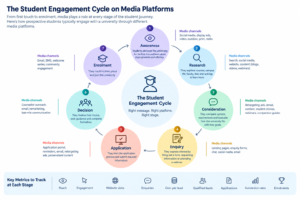
Media activity can therefore be mapped across different stages.
This full-funnel approach prevents the university from measuring every campaign using the same objective.
Impressions and clicks can tell part of the story, but they do not necessarily explain whether media activity is contributing to admissions. The metrics used to evaluate media performance can also change as students move from awareness to research, enquiry, application and enrolment.
Lead quality is particularly important.
A campaign that generates thousands of enquiries may not necessarily be useful if many of those enquiries come from students who are not eligible, are interested in another programme or are outside the university’s target market. This is why universities need a media partner that can connect audience targeting, campaign execution and performance data rather than treating each activity separately.
Universities need more than individual media campaigns to reach prospective students effectively. They need a partner that understands their audience, recruitment goals and the different stages of the student journey. GrowthTrack brings these elements together through its Media Planning & Buying services, helping universities plan, manage and optimise their media campaigns.
GrowthTrack’s Media Planning & Buying service offers universities help with-
The right partner should connect these capabilities rather than treating media as a standalone activity. Connect with us to discuss your goals and explore how we can help you build a smarter media strategy for your institution.
For universities, effective media planning connects audience understanding, channel selection, campaign management and performance measurement with the wider student recruitment journey. A structured approach can help institutions make more informed media decisions while adapting campaigns as student behaviour and recruitment priorities change.
A media marketing agency for education plans, purchases, manages and evaluates advertising campaigns for universities and other educational institutions.
Media planning helps universities decide which audiences to target, which channels to use, when campaigns should run and how budgets should be allocated.
It involves planning a university’s advertising strategy and purchasing media placements across channels such as search, social media, display, video, outdoor and other platforms.
Universities can use a combination of search advertising, social media, display, video, programmatic, publications, outdoor, print and radio, depending on their audience and campaign objectives.
Common measures include reach, engagement, website traffic, enquiries, cost per lead, qualified leads, applications, conversion rates and enrolments.
Not necessarily. The right mix depends on the university, its audience, location, programme and recruitment objectives. Digital may form an important part of the plan, while offline channels can also have a role.

Address:
A-68 First Floor, Sector 2, Noida, Uttar Pradesh 201301
Call Us At:
+91 7678631643
Email Us At:
business@thegrowthtrack.com
Copyright © 2026 @ growthtrack . All rights reserved.