



| August 26, 2026
Choosing an educational institution is rarely based on a single factor. Students and parents consider academic programmes, faculty, placements, campus life, fees, location, facilities, student experiences and long-term career opportunities before making a decision. Increasingly, much of this evaluation happens online. According to the Ministry of Education’s latest available annual report, India had 1,213 universities, 46,624 colleges and 12,543 standalone institutions listed on the AISHE portal for 2022-23.
Recent student research highlights just how important these digital touchpoints have become. Edvoy’s 2026 Global Student Survey, based on responses from 850 prospective international students, found that 35.1% of students in India identified university websites as a key source of information, while 20.8% relied on social media and 18.2% on counsellors.
Today, a college’s brand is evaluated long before a student speaks to an admissions team. From search results and websites to social media and student stories, every interaction shapes perception.
This makes education brand building strategies an important part of higher education marketing. A strong brand goes beyond logos and taglines; it creates a consistent identity that students can recognise, understand and trust as they compare options.
Education is a high-involvement decision. Students are not simply purchasing a product or service; they are choosing an environment in which they may spend several important years of their lives. This is why institutional reputation matters. A prospective student may ask –
Brand building also helps institutions differentiate themselves when several colleges offer similar programmes. A strong education branding strategy therefore focuses on identifying what makes an institution distinctive and communicating those strengths in a way that is relevant to its target audiences.
Earlier, educational institutions could rely heavily on campus reputation, word-of-mouth recommendations, print advertising and admission brochures. These channels still have a role, but the student decision-making process has become much more digital.
Today, an institution’s website often acts as its first point of contact. Search results, social media profiles, videos, reviews, news coverage and online content can influence perception before a student ever speaks to an admissions counsellor.
This means brand building needs to extend across multiple digital and offline channels.
A strong education brand should communicate consistently through Website, Search Content, Social Media, Video Content, Public Relations, Alumni experience and Admissions Communication
The objective is not to make every communication identical. Instead, different channels should reinforce the same core identity.
Visibility is only one part of education brand building. An institution may receive substantial website traffic and social media engagement, but these numbers do not automatically translate into trust.
Students increasingly have access to multiple sources of information. They can read reviews, compare programmes, explore alumni profiles and discuss institutions with peers before making a decision. This makes authenticity increasingly important.
Educational institutions can build credibility by communicating both achievements and real experiences. Instead of relying entirely on promotional claims, content can provide useful information, address common student concerns and demonstrate expertise. The goal is to make the brand recognisable, useful and believable.
Brand building and student acquisition should not operate as completely separate functions. A prospective student may interact with an institution several times before applying – 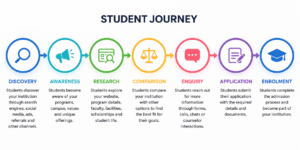
Brand communication can influence each stage. At the awareness stage, social media, videos, search content and public relations can introduce the institution. During research, programme pages, blogs, faculty profiles, student stories and FAQs can answer questions.
At the comparison stage, detailed information about curriculum, learning opportunities, facilities, outcomes and student experiences can help prospective students evaluate the institution. During the enquiry and application stages, counselling communication, email campaigns and personalised follow-ups can provide the additional information needed to make a decision.
This connected approach ensures that branding does not remain limited to awareness campaigns. It becomes part of the wider student acquisition journey.
Brand building can sometimes be difficult to measure because its impact may develop over time. However, institutions can monitor a combination of brand, engagement and admission-related indicators.
| Objective | Useful Metrics |
| Brand Awareness | Search impressions, branded searches, reach, media mentions |
| Digital Visibility | Organic traffic, social reach, video views |
| Engagement | Comments, shares, saves, content interactions |
| Consideration | Programme-page visits, repeat visits, brochure downloads |
| Interest | Enquiries, webinar registrations, counselling requests |
| Conversion | Applications, completed forms and enrolments |
| Reputation | Reviews, sentiment, student and alumni feedback |
Building an education brand requires more than creating attractive social media posts or publishing occasional blogs. It requires a clear understanding of the institution, its audiences, its competitive environment and the student decision-making journey. This is where GrowthTrack can support colleges and universities.
We approach education marketing by connecting branding, content, SEO and digital engagement rather than treating them as isolated activities. The focus is on helping institutions communicate their strengths in a way that is relevant to prospective students.
The approach can include:
For more information, you can get in touch with us.
Building a strong education brand goes beyond visibility or a recognisable identity. It requires consistent communication, authentic storytelling and meaningful engagement across websites, search, social media, content and admissions channels.
A well-planned education branding strategy helps institutions build trust, communicate their strengths and stay relevant throughout the student decision-making journey. By combining brand building with SEO, content, digital engagement and measurable outcomes, colleges and universities can strengthen their reputation, attract the right students and support long-term enrolment growth.
Education brand building strategies are planned activities used by colleges and universities to develop a clear identity, strengthen recognition and build trust among students, parents and other stakeholder
Branding helps institutions differentiate themselves, communicate their strengths and create a consistent impression across websites, social media, content, advertising and other student touchpoints.
Colleges can strengthen their online brand through useful website content, SEO, student stories, faculty-led content, social media, videos, alumni experiences, public relations and consistent communication.
Yes. A strong brand can influence the early stages of the student decision-making process by improving awareness, familiarity and trust. When combined with relevant programme content and effective admissions communication, branding can support the journey from discovery to application and enrolment.

Address:
A-67 Ground Floor, Sector 2, Noida, Uttar Pradesh 201301
Call Us At:
+91 7678631643
Email Us At:
business@thegrowthtrack.com
Copyright © 2025 @ growthtrack . All rights reserved.